Home / Variants
Want the three biggest styles side by side? See Rules compared .
Hong Kong & Southern Chinese 2 Hong Kong & Southern Chinese Guangdong Push-Down (Tui Dao Hu)
Guangdong, mainland China
A popular, simple southern style in which any complete hand wins — 'push down' your tiles — with straightforward payments and many local bonus rules.
Players 4
Tiles 136 or 144
Hand 13 (14 to win)
Scoring Simple fixed payments
Signature Win with any complete hand Hong Kong & Southern Chinese Hong Kong / Cantonese
Hong Kong, Guangdong and the Cantonese diaspora
The most widely played Chinese style outside the mainland: four sets and a pair, chows from the left, faan scoring and a table limit.
Players 4
Tiles 144
Hand 13 (14 to win)
Scoring Faan, doubling to a limit
Signature Fast play, faan minimum, flowers Read the full guide →
Mainland Regional Changsha
Hunan province
A Hunan style using only the three suits, in which an ordinary winning hand usually needs its pair to be a 2, 5 or 8.
Players 4
Tiles 108
Hand 13 (14 to win)
Scoring Local bonuses for special hands
Signature Pairs of 2, 5 or 8 required for standard hands Mainland Regional Sichuan (Bloody Battle)
Sichuan and Chongqing
Only the three suits are used, each player abandons one suit, and the hand continues until three players have won.
Players 4
Tiles 108
Hand 13 (14 to win)
Scoring Fan multipliers, play-on after wins
Signature No honours, no chows, one suit voided Read the full guide →
Taiwanese Taiwanese 16-Tile
Taiwan and the Taiwanese diaspora
A bigger hand of sixteen tiles makes wins faster and scoring richer; very popular online and at New Year.
Players 4
Tiles 144
Hand 16 (17 to win)
Scoring Tai plus a base payment
Signature Five sets and a pair Read the full guide →
Japanese Japanese Riichi
Japan and worldwide online
Japan's modern game, with a mandatory scoring pattern, a ready-hand declaration and deep defensive play. Professional leagues and huge online ladders.
Players 4
Tiles 136
Hand 13 (14 to win)
Scoring Han and fu
Signature Yaku requirement, riichi, furiten, dora Read the full guide → Japanese Japanese Three-Player (Sanma)
Japan
A faster, swingier three-player form of riichi with its own parlours and online ranks.
Players 3
Tiles 108
Hand 13 (14 to win)
Scoring Han and fu
Signature Characters 2–8 removed; North as bonus Read the full guide →
Southeast Asian Filipino
The Philippines
A sixteen-tile family game with many local bonuses, central to Filipino holidays and gatherings.
Players 4
Tiles 144
Hand 16 (17 to win)
Scoring Local bonuses
Signature Sixteen-tile hands, family house rules Read the full guide → Southeast Asian Singaporean & Malaysian
Singapore and Malaysia
Adds animal tiles to the flowers and seasons, with instant payments for some bonus combinations.
Players 4
Tiles 148 or more
Hand 13 (14 to win)
Scoring Tai with instant bonus payments
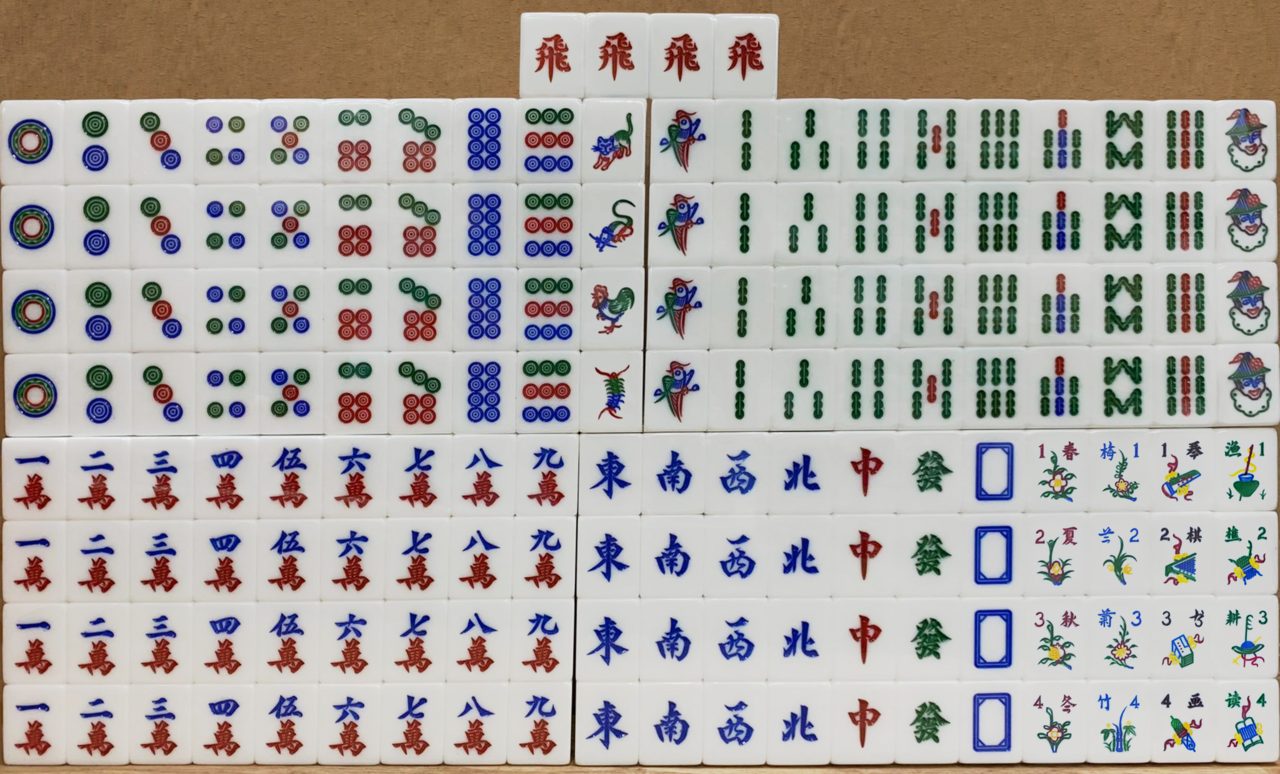
Signature Animal tiles: cat, mouse, rooster, centipede Read the full guide → Southeast Asian Vietnamese (Mạt chược)
Vietnam
Sets include many jokers and special bonus tiles, giving a looser, faster game.
Players 4
Tiles More than 144
Hand 13 (14 to win)
Scoring Varies by family
Signature Many jokers and special tiles Read the full guide →
American & Western American (NMJL)
United States
Winning hands come only from the National Mah Jongg League's annual card; the Charleston and jokers make it unique.
Players 4 (3 or 2 by special rules)
Tiles 152
Hand 13 (14 to win)
Scoring Fixed values on the annual card
Signature Annual card, Charleston, jokers Read the full guide → American & Western British Rules
United Kingdom
The rules developed by British clubs and writers from the 1920s, still played by some groups.
Players 4
Tiles 144
Hand 13 (14 to win)
Scoring Points and doubles
Signature Classical Western scoring Read the full guide → American & Western Western Classical (1920s rule books)
English-speaking world
The doubles-based scoring of the 1920s Western rule books that introduced the game to English speakers.
Players 4
Tiles 144
Hand 13 (14 to win)
Scoring Base points plus doubles, with a limit
Signature Babcock-era rules Read the full guide → American & Western Wright-Patterson
United States military communities
A variant named after Wright-Patterson Air Force Base in Ohio, with its own published rules, still played in some communities.
Players 4
Tiles Varies
Hand 13 (14 to win)
Scoring Its own published hand list
Signature Post-war American variant Read the full guide →
Competition & Modern Chinese Official (MCR / Guobiao)
International tournaments
Published in 1998 for competition: an 81-pattern scoring list and an eight-point minimum. Used for world and European championships.
Players 4
Tiles 144
Hand 13 (14 to win)
Scoring 81 patterns, 8-point minimum
Signature Skill-focused competition rules Read the full guide → Competition & Modern Tournament Riichi (international rules)
World and European riichi events
Riichi rules standardised for international tournaments, usually without red fives or with restricted optional yaku.
Players 4
Tiles 136
Hand 13 (14 to win)
Scoring Han and fu, fixed uma
Signature Standardised for fair competition Read the full guide → Competition & Modern Zung Jung
Online and club play
A modern Chinese rule set balancing classic hands with clear, compact scoring.
Players 4
Tiles 136
Hand 13 (14 to win)
Scoring Compact pattern list
Signature Designed in 2006 by Alan Kwan Read the full guide →

 Hong Kong & Southern Chinese